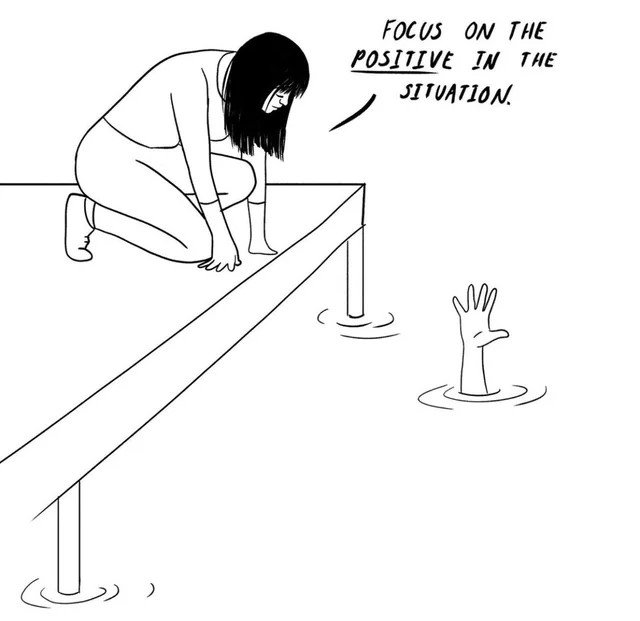
“Everything happens for a reason.”
“God won’t give you more than you can handle.”
“No worries.”
How many moments have you had to endure the aforementioned inane, cringe-worthy, insufferable, idioms of the idiotic?
We are force-fed optimistic colloquialisms daily, whether our personal nutritional guidelines want to digest them or not.
We recently touched on toxic positivity — the act of avoiding, suppressing, or rejecting negative emotions or experiences. This may take the form of denying your own emotions or having someone else deny your emotions and insisting on positive thinking instead. And, although setting aside difficult emotions is sometimes necessary temporarily, denying negative feelings long-term is harmful because it can prevent people from processing their emotions and overcoming their distress.
Let’s do a deeper dive on this desperate and annoying craze, sweeping the nation and world-at-large.
What are examples of toxic positivity?
It hinges on the failure to acknowledge or accept someone’s negative emotions.
Examples include:
Statement: “I don’t know if I can have a relationship with my sister. She doesn’t treat me with decency and respect.”
Response: “She’s family. You should love her no matter what.”
Statement: “Work has been really stressful lately.”
Response: “You’re lucky to even have a job.”
Statement: “I’m having a hard day.”
Response: “But you have so much to be grateful for.”
In these examples, positivity is used to deny negativity. An alternative response might include accepting the person’s emotions and demonstrating patience.
In a survey by the Science of People, more than 75% of respondents admitted they have rejected or ignored their own emotions in an attempt to force happiness.
Research in the Journal of Behavioral Medicine revealed that habitual emotional suppression significantly predicts elevated inflammatory burden and flatter cortisol slopes, proving that bottling up feelings alters the body’s physical response to chronic stress.
Experimental studies conducted by Dr. James Gross at Stanford University showed that when individuals force themselves to avoid negative feelings during an upsetting event, it amplifies their autonomic and cardiovascular responses, (higher heart rate and blood pressure), instead of easing distress.
A thematic analysis of academic articles shared by the Journal of Workplace Mental Health proved that corporate environments pushing a hyper-positive culture, experienced a substantial increase in employee stress, severe burnout, and acute emotional isolation.
Psychological research highlights that when individuals are explicitly told not to think about a negative emotion, it triggers an ironic rebound effect, making them more likely to fixate on the distress and experience secondary guilt or shame.
According to experimental data, suppressing emotions does not just hurt the individual; it physically elevates the blood pressure of their interaction partner as well. This breeds lower social support, less intimacy, and severe relationship dissatisfaction.
A series of experiments published in Body Image discovered that “pressuring” pro-body positivity messages produced more psychological pressure, lower personal agency, and lower self-esteem compared to messages that simply supported autonomous self-acceptance.
Chronic or terminal illness patients are often told to “fight with a positive attitude” or “visualize healing,” which subtly blames them if their health worsens.
Society gives grieving individuals an incredibly short window to feel pain before expecting them to “move on” and “find the silver lining.”
Let us not forget, performative happiness. Social media platforms demand a curated feed of success, fitness, and joy.
It is time society starts to normalize negative emotions!!
Understand that it is okay to feel angry or anxious. These emotions are a natural part of the human experience and can provide valuable insights into your needs and values.
When someone shares their struggles, resist the urge to “fix” them or offer platitudes. Instead, focus on listening. A phrase like “That sounds difficult,” can go a long way.
While optimism has its place, it is essential to recognize when it becomes excessive or dismissive. Avoid pushing positivity on others and be mindful of your own emotional needs.
Rather than striving for constant positivity, aim for self-compassion. Treat yourself with kindness and understanding, especially during challenging times.
In the end, the TRUTH — (to reiterate for the fascistic among us, AND yes, YES, toxic positivity can be described as fascist or authoritarian in nature when looking at how it functions as a mechanism of control, social policing, and ideological compliance) — IS toxic positivity:
- Denies challenges by ignoring or invalidating the reality of difficult situations.
- Encourages avoidance by promoting the ignoring of problems rather than addressing them.
- Suppresses emotions by discouraging the expression of negative feelings, leading to emotional repression.
While healthy alacrity:
- Acknowledges challenges by recognizing difficulties while maintaining hope for improvement.
- Encourages action by inspiring problem-solving and resilience rather than avoidance.
- Supports emotional balance by allowing space for positive and negative emotions.
Remember, it is alright not to be alright, and acknowledging that is the first step toward genuine growth.
So, the next time someone tells you to manifest good thoughts exclusively, tell them, “go f**k yourself,” but do so with good vibes only, of course.
Did You Know? A major 12-year longitudinal study published by the National Institutes of Health (NIH) found that higher levels of emotional suppression – the core mechanism of toxic positivity – were significantly associated with an increased risk of all-cause mortality and cancer mortality.