“Winter is an etching, spring a watercolor, summer an oil painting, and autumn a mosaic of them all.”
Football in its truest essence is a sledge hammer meets a violin. There in the perfection of precision is heartache amidst triumph; foresight entangled with the pressure of perplexity. It lifts and bows; it breathes through suffocation; it ends without finite resolution; and sustains through fate; it rests knowing victory is within and without; it strives to answer only that which is present, yet evolves because of its past.
A brief history …
Although football has been played in one form or another for centuries, the American version of the sport originated, for the most part, in Northeastern high schools and matured during the late nineteenth century in the Ivy League universities of the Northeast. As early as the 1840s, intramural matches had assumed a significant place in the campus life of students at Harvard and Yale University. Rivalries between classes became so intense that, by the beginning of the Civil War, the game had to be outlawed by the administrations of both institutions.
During the war years, a young man named Gerritt Smith Miller, who had played football while a high-school student in upstate New York, organized the Oneida Football Club in Boston, Massachusetts. He was the first to introduce the concept of teamwork to the game. Up to this time, players functioned individually on the field, with little regard to what their teammates were doing. Miller’s “Boston game” assigned each player a role in advancing the ball or defending the goal.
Princeton and Rutgers played the first intercollegiate football game in 1869, with Yale, Cornell, and Columbia following soon after. Most closely resembling soccer, (ball carrying was not yet considered an option), the earliest games were melees in which roughly 25 men blocked, tackled, and fought to kick a round, leather-covered ball through a wooden crossbar.
In 1869, after a Harvard–Yale agreement, a game marrying the soccer rules with rugby rules was played, (adding ball carrying with kicking), and American football was born.
With college football deeply established in the culture, it was time for a professional league, which started in 1920.
Early pro teams relied entirely on players coming straight from the college ranks, using the pre-existing popularity of collegiate stars to attract ticket buyers in Midwestern industrial towns.
While college football dominated the first half of the 20th century, the NFL’s massive rise to supremacy began around the 1958 Championship Game, often called “The Greatest Game Ever Played.”
Let’s take a look at some of the reasons why people love the NFL …
NFL is part of American tradition
Every Sunday during football season, fans across the country will gather to watch a game regardless of who is playing. This includes holidays. For most, Thanksgiving would not be complete without tossing around a football or watching the games with your family.
NFL fosters relationships
From jeering at a bad referee decision to throwing your hands in the air after an exceptional field goal on fourth down, watching a game with others offers the full camaraderie experience.
Tailgating is fun
Who doesn’t like firing up the grill and sharing grog and grub with other fans in stadium parking lots before, during, and after a game. The barbecue haze beckons spectators to enter the gates of their favorite teams. These spaces often are open more than four hours before the main game to allow fans to set up camp for the day.
People revel in watching talent
Gifted athletes are a joy to witness in any sport and the NFL has exceptional talent in every game. NFL teams feature a wide variety of players who use their diverse abilities to perform incredible athletic feats.
NFL hits hard
Football is a fast-paced game that pulls no punches. Players do not roll around on the floor grabbing their ankles and calling for penalties every ten minutes. Few sports are as action-packed and exciting. From a linebacker in ferocious pursuit to the star quarterback driving his team down the field, these games are full of drama and athletic prowess that keep fans on the edge of their seats.
NFL has the best final
Even people who do not watch sports watch the Super Bowl. It is undoubtedly one of the biggest sporting events in the world. The Super Bowl has been known to draw more than 100 million viewers from across the globe and has practically reached national holiday status in the U.S. In addition to the game, the Halftime Show adds to the enormity of the spectacle.
There is a chance to win big
While not all football fans gamble on the games, the comprehensive structure of the NFL makes it extremely easy to place bets. The abundance of information and sites offering an online sportsbook helps punters accurately gauge the odds and make predictions. Watching a game that you have a stake in can make it all the more exhilarating. You will be cheering the loudest on the grandstands when you and your team win big.
So, go squeeze your noggin through a hoodie adorned with your team’s logo, grab a pumpkin ale, start thinking about the sauces which will delectably coat your mother cluckers, and remember …
“The Autumn Wind is a pirate.
Blustering in from sea,
With a rollicking song, he sweeps along,
Swaggering boisterously.
His face is weather beaten.
He wears a hooded sash,
He growls as he storms the country,
A villain big and bold.
And the trees all shake and quiver and quake,
As he robs them of their gold.
The Autumn Wind is …
Pillaging just for fun.
He’ll knock you ’round and upside down,
And laugh when he’s conquered and won.”
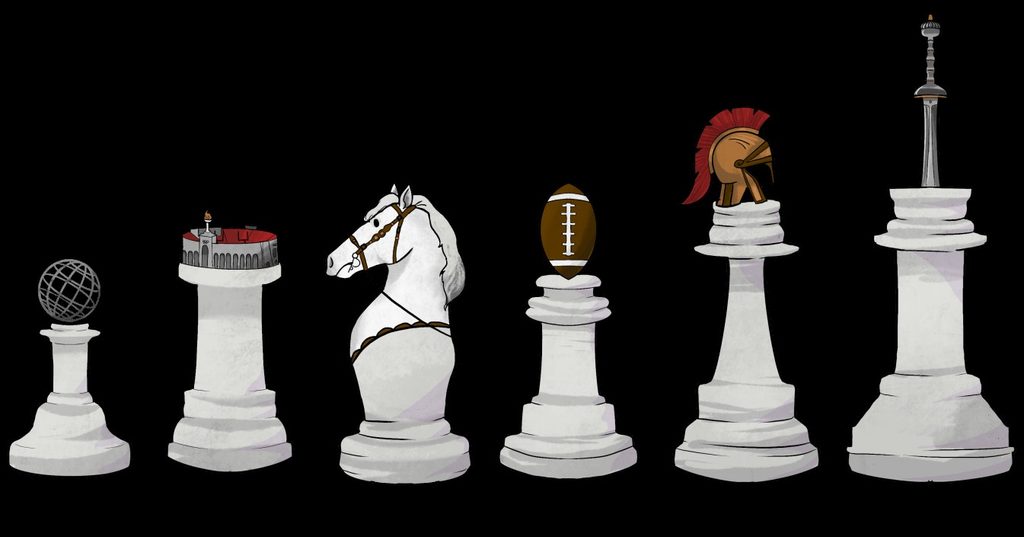
Did You Know? American football is like chess because both games rely on positioning 22 pieces on a defined grid to outsmart an opponent through strategy, spatial control, and anticipatory moves. While chess is a turn-based, perfect-information game and football is played in real-time with physical contact, the mental parallels are profound.